
English Deutsch
Carsten Büche

Professional Enterprise Test Automation with OpenText™ UFT / ALM

Architecture, stabilization and scaling of GUI test automation with OpenText UFT for complex desktop and legacy enterprise systems.

Stable regression testing for SAP GUI, WPF, WinForms and other difficult-to-automate applications.

Stabilization of fragile UFT test automation and reduction of maintenance effort by 30–70% through structured test frameworks.

  • Over 15 years of experience in enterprise test automation
  • Specialist in OpenText UFT UIA / UIA Pro
  • Framework engineering for stable regression testing
  • Architecture for scalable GUI test automation

Enterprise systems for stable UFT GUI test automation

  • SAP GUI
  • Windows Presentation Foundation (WPF)
  • Windows Forms
  • Oracle Forms
  • Complex legacy desktop applications
For QA teams in:
  • Banking
  • Insurance
  • Enterprise software projects

I support organizations with complex desktop and legacy systems

Free 30-minute analysis of your test automation

Available for projects in Germany and remote

I develop reusable UFT test frameworks that speed up your test operations

Consulting, framework development and coaching for test organizations. Focus: robust, maintainable automation with UFT.

I develop professional, scalable UFT frameworks – including UIA/UIA-Pro automation, ALM integration, VBS/Excel libraries and modular test architectures.

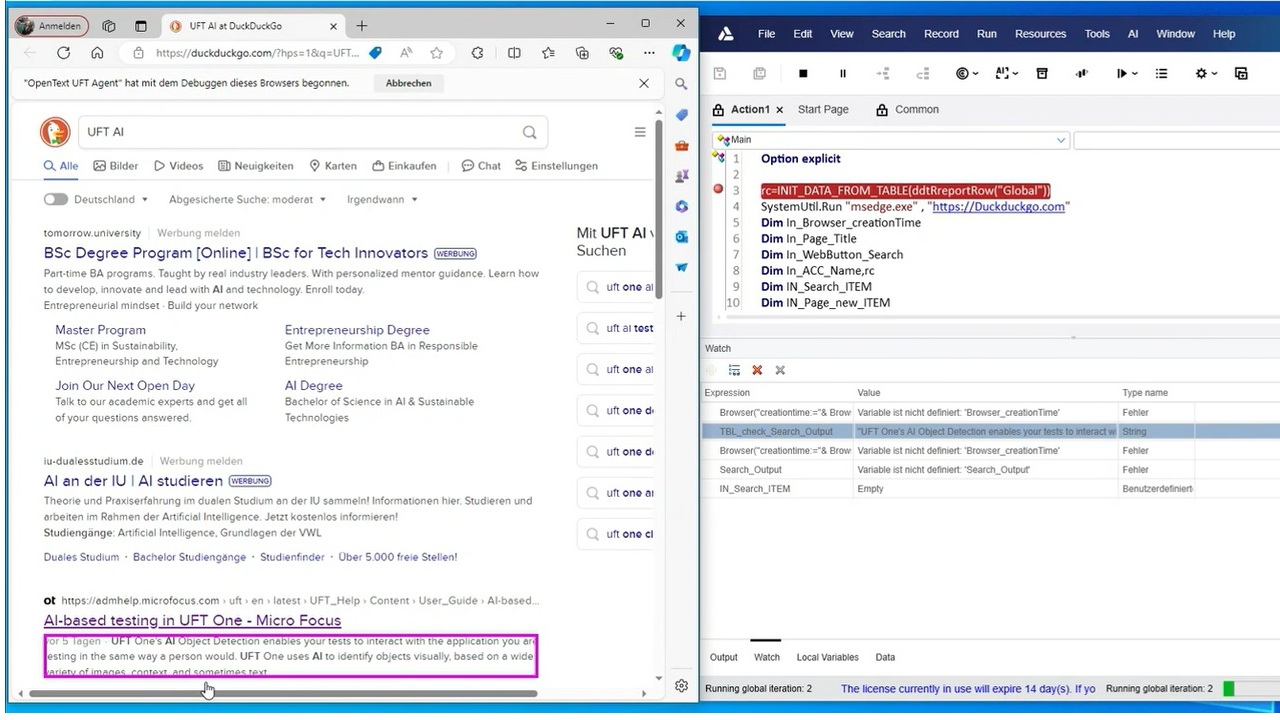
UIA stands for Windows UI Automation and provides the technical foundation that allows UFT to perform both traditional and AI-powered recognition of desktop elements.

What is UFT Testing?

UFT Testing refers to the use of OpenText UFT One (formerly Micro Focus UFT, HP UFT or QuickTest Professional/QTP). It is one of the leading solutions for automating functional software tests and enables end-to-end automation for web, desktop, mobile and API applications.

UFT (Unified Functional Testing) is a commercial, AI-enhanced automation tool that makes functional tests and regression tests efficient and reproducible. Test scripts can be recorded, modularized and executed automatically as often as required.

Main features

  • Automation of UI and API tests in a unified interface
  • Object-based recognition for stable identification of UI elements
  • AI-supported object recognition and improved handling of dynamic interfaces
  • Support for Web, Java, .NET, SAP, Oracle, legacy systems and more
  • Data-driven testing via DataTable, Excel or external sources
  • Seamless integration with ALM, Jenkins, Git and DevOps pipelines

Benefits

  • Significant reduction in manual activities
  • Reliable regression tests through repeatable processes
  • Stronger error prevention through automated checks
  • Significant time savings, especially in release cycles

Projects

Over 15 years experience

in test automation and framework engineering make me a reliable partner for companies that take quality seriously.

I combine analytical thinking, precise structure and strategic approach to detect defects, optimize processes and create stable, scalable test frameworks.

My mission: design processes efficiently, minimize risks and measurably improve software quality.
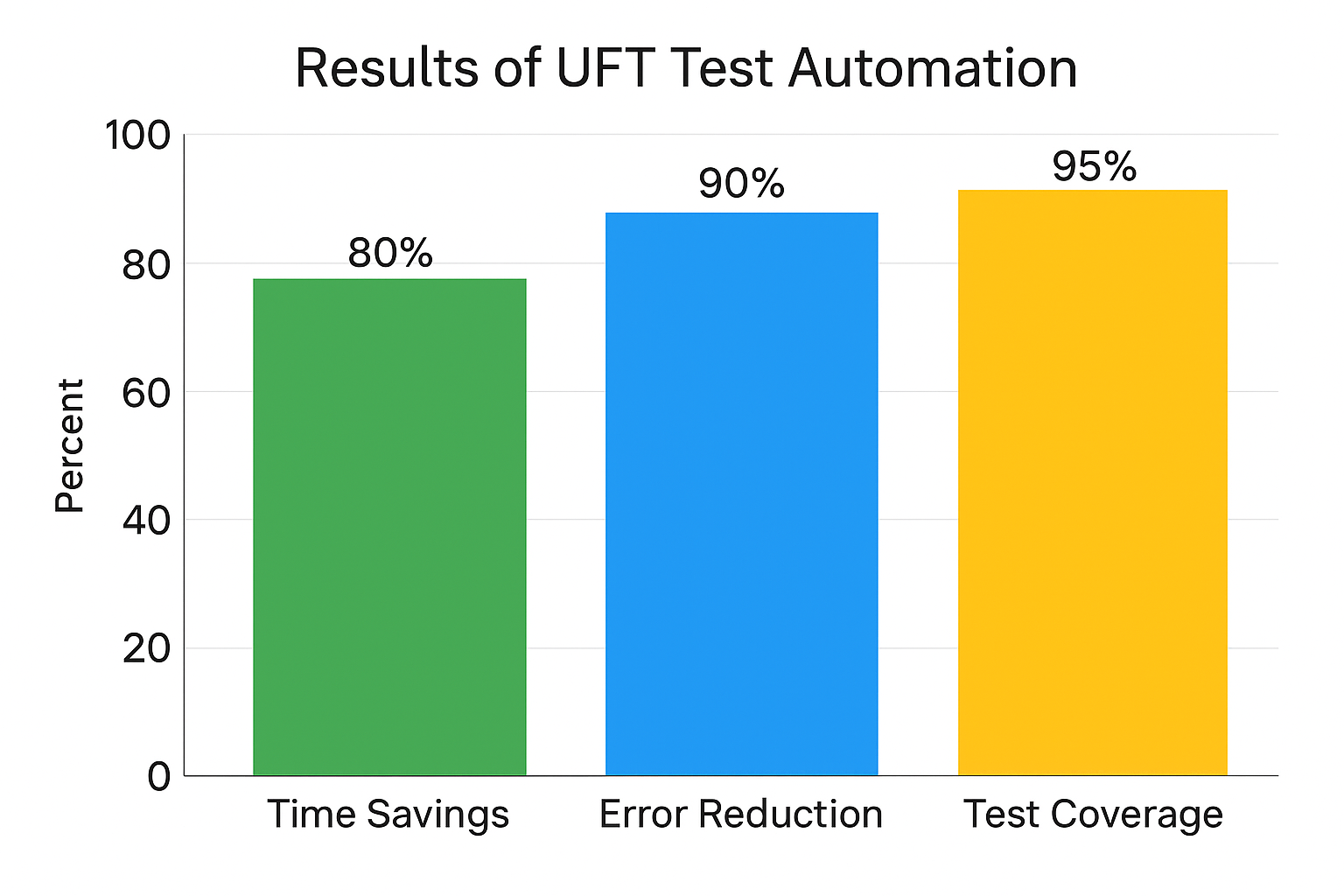
UFT ROI Case Study

UFT ROI Case Study Result

Click “PDF download” to download the file or “Preview” to open it in the browser.

PDF download

100% Automated Scenarios
  • UFT Test Automation: Complete automation of desktop and web applications
  • UIA (User Interface Automation): Standardized object recognition via properties and methods for desktop and web apps
  • UIA Pro: Use of the Microsoft UI Automation framework for .NET, WPF and WinForms applications; reliable recognition of modern UI components
  • Creation and maintenance of scalable frameworks & libraries specifically for UFT UIA
  • Hierarchical test flows & process optimization with focus on UIA compatibility
  • Debugging & analysis of complex systems in the UIA environment
~70% time savings in regression testing through a tailored UFT/ALM test framework with UIA and UIA-Pro technologies.

Key Benefits

  • Reusable UIA and UIA-Pro components
  • Modular framework architecture for quick maintenance
  • Abstract function libraries with VBScript & Descriptive Programming
  • Stable UI recognition for desktop, WPF, WinForms and web interfaces
  • Direct ALM linking for automated documentation and reporting

Technical Levers

  • Keyword-Driven / Hybrid Framework Structure
  • UIA & UIA Pro for consistent object recognition
  • Descriptive Programming instead of Object Repository
  • Automated test runs and logs in Micro Focus ALM

Result

  • ~70% less effort in regression
  • Stable, low-maintenance test automation
  • Faster releases through secured quality
  • Reduced error rate through robust UIA technology
Book a UFT Framework Assessment Teams & ICS

Services

Consulting & Strategy

📊

Analysis of existing test processes, roadmap & prioritization.

  • Assessment of current tests & toolchain
  • Migration planning to UFT/ALM
  • Proof-of-concept (pilot)

Framework Development

⚙️

Modular, maintainable UFT framework with reusable libraries.

  • Folder & naming conventions
  • Data-driven / Keyword-driven concepts
  • Integration into CI & ALM

Training & Coaching

🎓

Hands-on training for testers & DevOps teams.

  • UFT best practices
  • Creation of descriptive libraries (VBS)
  • Onboarding & mentoring

Core Services

References & Results

Banking App — Regression

Built a framework, enabled parallel tests, result: regression reduced from 4 days → 6 hours.

Technologies: UFT, ALM, VBS

Insurance — Module Tests

Descriptive function libraries (Excel-driven) reduced script creation by 60%.

Technologies: UFT, Excel, ALM

💬 Show client testimonials

Client testimonials

“The implementation was pragmatic and effective — our release cycle improved considerably.” — Senior QA Manager
“Mr. Büche worked as an external employee with us from February to November 2018 in the field of test automation for bahn.de. His tasks included test execution with Micro Focus Application Lifecycle Management ALM and test evaluation, as well as the further development, maintenance and, if necessary, adaptation of test cases and the underlying framework functions. Thanks to his comprehensive experience, Mr. Büche was able to take over these tasks independently after a short familiarization period and carry them out successfully. In addition, Mr. Büche further developed the test execution documentation in ALM and improved or completely fixed various problems in the test automation programming.” — Senior Test Manager
“Mr. Büche was commissioned as an external consultant from July 2016 to April 2017 in the project "Selection and introduction of a solution for test automation of SAP CRM 7.0" by VBL to set up and introduce test automation using Hewlett Packard Enterprise - Unified Functional Testing 12.5 (HP UFT). Mr. Büche performed the following tasks within the project as part of the agreed goals: Aufbau eines Framework für modulare Testfallerstellung in HP UFT mittels Libraries in VBS für wiederverwendbare Funktionen; Entwicklung von systemübergreifenden Testskripten für ein NetWeaver Business Client (NWBC) SAP CRM sowie SAP ERP System; Modular structure of test scenarios and parameter transfer of variants from Excel tables; Documentation of the HP UFT based framework and its extension to "Test Driven Development" as well as libraries with the functions; Extension of the framework for configurable adaptation to different runtime environments and software versions; Coaching and handover of the framework to the test team; Introduction of test reporting based on HP report facilities. Mr. Büche quickly familiarized himself with the technically new area based on his solid knowledge and experience with HP QTP and UFT. The solution approaches he designed were always purposeful and pragmatic, so the implementation of the requirements for the framework and the test scenarios for the test object could be used correctly within the planned time. Mr. Büche worked with great care and thus achieved very good results in qualitative and quantitative terms. Through his conceptual, creative and logical thinking, he always found excellent solutions to all problems that occurred. He always worked very quickly, result-oriented and precisely. Reliability and trustworthiness characterized his working style. Collaboration with him was very goal-oriented and efficient and characterized by respectful interaction.” — Project Manager

Technical Articles & Best Practices

📘 Best Practices for Robust UFT Frameworks

Best Practices for Robust UFT Frameworks

Quick guide: structure, error handling, and reusability.

1. Framework Structure / Architecture

Modular Design with Actions

🎥 Video: UFT UAI – Descriptive Programming in Function Libraries

  • Use Reusable Actions for recurring business processes (e.g., login, navigation).
  • Limit the number of actions per test to avoid performance issues.
  • Each action should follow Single Responsibility.

Layered Architecture

  • Test Layer: test logic (what to validate).
  • Business Layer: business operations (e.g., "create customer").
  • UI Layer: object handling (Object Repository or Descriptive Programming).

Object Management

  • Use a Shared Object Repository (TSR) for centralized management.
  • Use Descriptive Programming for dynamic UI elements.

Data Management

  • Data-Driven Testing: use UFT DataTable or external sources (Excel, DB).
  • Separate test logic from test data.

CI / Execution

  • Integrate tests into CI/CD pipelines.
  • Execute tests in parallel or batches to reduce runtime.

2. Error Handling (Robustness)

Error Handling

  • Use On Error Resume Next carefully and validate Err.
  • Log errors using Reporter.ReportEvent and reset with Err.Clear.

Recovery Scenarios

  • Use UFT Recovery Scenarios for popups and unexpected failures.
  • Define trigger → action → post-recovery clearly.

Synchronization

  • Use WaitProperty, Sync, or Exist.
  • Avoid fixed Sleep statements.

Logging & Reporting

  • Capture screenshots, error messages, and context.
  • Use structured Reporter events (Pass / Fail / Warning).

3. Reusability & Maintainability

Function Libraries

  • Store reusable VBScript functions in shared libraries.
  • Organize by domain or UI component.

Naming & Standards

  • Use clear naming conventions.
  • Apply version control and code reviews.

Test Isolation

  • Tests should run independently.
  • Avoid shared state between tests.

Maintenance Strategy

  • Plan maintenance cycles after UI changes.
  • Track metrics: runtime, failure rate, flakiness.

4. Strategic Recommendations

  • Training: ensure team alignment on framework standards.
  • Feedback loop: distinguish test vs. application defects.
  • Documentation: maintain clear architecture and onboarding docs.
⚙️ ALM / Octane Integration in CI/CD Pipelines

ALM / Octane Integration in CI/CD Pipelines — integrating work items into automated releases

Orchestration, traceability, and automated test result uploads (UFT, API, Selenium).

1. Target Architecture

  • CI/CD builds, executes tests, and writes results back to ALM/Octane.
  • Automatic updates of stories, risks, defects, and test runs.

2. Integration Model

CI/CD → ALM (Bottom-Up)

  • Pipeline triggers tests.
  • Results pushed via API or plugin.
  • Linked to work items automatically.

ALM → CI/CD (Top-Down)

  • Octane triggers pipelines.
  • Controls test selection.
  • Manages quality gates.

3. Tool Integration

  • Jenkins / Azure DevOps / GitLab pipelines
  • UFT One / UFT Developer execution
  • Automatic reporting to ALM/Octane

4. Governance & Quality Gates

  • Minimum automation coverage
  • No critical defects
  • All pipelines must pass

5. Best Practices

  • Clear mapping between tests and work items
  • Consistent naming conventions
  • Fully automated result uploads
© Guide — ALM/Octane Integration for CI/CD Teams

Contact

Next steps (proposal)

1. Quick Assessment (1 day)

Quick analysis of your current test landscape and priorities.

2. Pilot (2-4 weeks)

Proof-of-concept for critical scenarios with measurable ROI.

3. Rollout & Coaching

Rollout of the framework, team training, knowledge transfer.